The following story is Part Two of the history of the Baughman and Ritter families, a continuation of the 'Pioneer History' column from last month. Author Philip Ritter has compiled a wealth of information concerning these two families, early settlers of South Lake County.
The West Creek Baughman and Ritter Families
Part 2
By Philip Ritterphilr@stanford.edu
Last month we described 11 Baughman and Ritter families who moved from Tuscarawas County, Ohio, to West Creek Township in the early 1850's. Not all of these families were to remain in West Creek indefinitely.
In late 1855 Jacob Baughman and George Ritter died, apparently within weeks of each other. Although both men were relatively young (in their 50's), they were the oldest familiy heads among their siblings. Their deaths must have loosened the ties that held the Tuscarawas/West Creek families together.
A family story relates that George Ritter had caught a contagious disease while visiting a sick member of his congregation. Perhaps there was a lethal epidemic at that time. George had been listed as a "Dunkard" (German Baptist Brethern) preacher in the 1850 Ohio census, and it seems likely that he tried to form a Brethern congregation at West Creek.
But with his death, the effort must have failed, as there are apparently no records of a Brethern church ever existing in this part of Lake County.
Other members of the Baughman and Ritter families joined various other churches in the area, but George's sons remained Brethern and soon moved to northern Kosciusko County, Indiana. A large number of families from Tuscarawas had migrated to Kosciusko in the 1840's, including George Ritter's brother, John Jr., and Jacob Ritter's brother-in-law, Peter Hamman. By the 1880's all four of George's sons were in Kosciusko. George Ritter's daughters remained in West Creek only a little longer, but they all left eventually. Mary Ritter Ammerman moved with her husband to Iowa, and Cynthia Toms and her husband went to Kansas. Harvey Toms had married Cynthia Ritter after his first wife, Mary Ritter (Cynthia's first cousin) died in West Creek.
The other three daughters soon joined their brothers in Kosciusko. By the mid-1860's, all of George Ritter's children had left West Creek Township, and his "unimproved" land had been sold.
The Civil War of the 1860's proved a turning point for many of the families. George Ritter's sons did not serve, being exempt as conscientious objectors. (The Brethern religion, like the Mennonites and Quakers, is one of the historic "peace" churches.)
However, three of George's sons-in-law joined the Union Army, as did his brother, Jacob Ritter, and several other sons and sons-in-law of the West Creek Baughmans and Ritters.
Adam Mock died in Mississippi in 1863, and his widow, Louisa Ritter Mock, soon moved to Kosciusko to join her brothers.
Of those who survived to return home after serving in the Union Army, few remained in West Creek for long. Perhaps exposure to the larger world while in the service, or perhaps restlessness engendered by the horrors of war, contributed to the desire to move on. John F. Ritter, Harvey Toms and Samuel Baughman went to Kansas, Dr. William Ammerman to Iowa, Andrew Livingston and Thomas Baughman to Michigan, John Baughman to Washington state, and Wilson S. Baughman to Missouri. Charles Hoevet and his father-in-law, Jacob Ritter, remained in the area for two more decades, then migrated to Nebraska.
An 1869 letter that Abraham Ritter wrote from West Creek to his son, John F. Ritter, in Kansas, tells of sickness, cold weather, poor prices for crops, and the death of their milk cow. Abraham notes that "Ant Salley" (Jacob Baughman's widow) had come to live with them after Abraham's wife became sick. Perhaps another reason so many Civil War veterans moved on was that economic conditions were not good in south Lake County immediately after the war.
Some of the former West Creek families continued the earlier pattern of moving west together. When Harvey Toms applied for a Civil War pension from Coffey County, Kansas, a neighbor who filled out an affidavit on his account was none other than Jacob Baughman's son, Samuel, who talked of knowing Harvey when he was a strong young man in Lake County.
Samuel did not mention that he was a first cousin of Harvey's wife, Cynthia Ritter. Several of Jacob Ritter's married daughters ended up near each other in Dawes County, Nebraska, after having lived in other places in Iowa and Nebraska.
Many of the families maintained contact with each other. Charles Hoevet married Jacob Ritter's daughter, Elizabeth, in West Creek in 1859 and shared a household with his wife's cousin, John Baughman, at the time of the 1860's census.
Click on photo to enlarge it 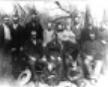 The Charles Hoevet Family
The Hoevets then moved to Yellowhead Township across the Illinois state line in Kankakee County, where Charles became a county supervisor and a leader in the Republican Party. In 1880 he moved to Nebraska, where descendants can be found today.
In a letter written to his wife's cousin, Abraham Ritter, at Kosciusko in 1887, Charles asks who has married since he was last in Kosciusko, asks about Abraham's recent trip to Michigan, and asks whether Abraham had been to visit his land in Missouri. He also notes that Abraham would find southern Missouri more suitable than Nebraska, since "you could hardly get along without timber, being so used to it, but we don't miss it for I can fence cheaper and quicker with wire than you can with rails [wooden fence]."

Clearly, these families remained familiar with each other even when living 900 miles apart.
Although many of the Ritter and Baughman families moved on after the 1850's, a core remained in or near West Creek Township, west of the town of Lowell. Years later, Buelah Plummer Brannon wrote how the home of her grandmother, Katherine Baughman Plummer, served as the Thanksgiving gathering place for numerous Baughman, Plummer, Knisely and Hayden relatives.
Katherine's brother, Jacob Baughman, spent two extended periods on the west coast prospecting and mining for gold and silver, but always returned to West Creek or Lowell, where he invested his hard-earned mining profits to become relatively wealthy. [Pioneer History, Nov. 18, 1984, 'Gold Fever'].
When he died he left money to his sister's granddaughters as well as his own granddaughter.
Beulah Plummer earned a degree from Northwestern University and taught at several women's colleges before returning to marry and live in Lake County.
Many Hayden-Knisely descendants (from four marriages between daughters of Barbara Baughman Knisely and sons of 1837 pioneer Nehemiah Hayden) remained in West Creek or nearby Kankakee. Two of Jacob Ritter's daughters married into the Hayhurst family of Kankakee County, and one granddaughter, Bessie Hayhurst, married a Hayden and remained in Lowell.
According to one family account, Louisa Ritter Livingston divorced her husband, Andrew, to remain on the West Creek land she inherited from her father, Abraham Ritter, rather than follow Andrew to Michigan.
The children and grandchildren of the Baughman and Ritter settlers who remained in the West Creek area eventually joined their parents and aunts and uncles in the West Creek, Lake Prairie or Lowell cemeteries. When I visited the West Creek Cemetery a few years ago, there were flowers on Louisa Livingston's grave.
It has been just over 150 years since Jacob Baughman and George Ritter led their families from eastern Ohio to West Creek. Although both Jacob and George died less than five years later, the flowers remind us that 150 years later, there are still members of their families in the vicinity of southern Lake County.