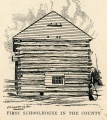
 Early Cedar Lake School |
||
Early Cedar Lake School |
||
Jane Ayrault (pronounced A-ro) Horton had a fine education and studied under the guidance of several renowned teachers, including one at Hartford, an author and professor of botany, Dr. Sumner. She was acquainted with leaders in literary and social life in the city between the years 1819 and 1824.
On November 11, 1824, Jane married Hervey Ball (1794-1868), son of Lt. Charles Ball . They had four sons: Timothy, born 1826; Heman, 1832; Charles, 1834; and James, born 1836. Their three daughters were Elizabeth, 1829; Mary Jane, 1839; and Henrietta, 1841.
The Ball family was staying at the Horton estate after the death of Dr. Timothy Horton when the land and home were being sold and all the servants had been dismissed. There was great excitement as the stage arrived from Springfield to take them to Hartford, Conn.; a large wagon was there to take their luggage for the first part of their journey to Indiana. Aboard the stage were Hervey and Jane Ball, their four sons and one daughter. (Mary Jane and Henrietta were born in Indiana.) Joining them for a while were grandmother Horton and great-grandmother Hammer, who stayed back east, never to see the Ball family again.
The Ball family traveled on a steamboat up the Hudson River to Albany, New York, where they went aboard a boat on the Erie Canal. "Day by day, the horses jogged along the tow path, and the loaded boat followed. Many pleasant incidents took place "as we sat on the deck and watched the scenes along the bank and the filling up of the locks and the ascent of the boat," as Timothy Ball wrote from his memories of the trip at age 11. Parents Hervey and Jane were watching carefully so that none of their brood would fall into the canal.
Trumpets blew to announce their arrival at Buffalo, New York, then a young city with an ice-bound harbor. Jane and Hervey with their children then boarded a large heavily loaded steam ship which began to plow a path through the ice floes until open water was reached and where there was a heavy gale. The big steamship landed at Toledo, Ohio, where Hervey Ball bought an expensive five horse team and a large covered wagon, and they began the long trip through the wilderness to Indiana. They traveled across Michigan because many travelers had made a trail from Detroit to Chicago, an easier route than through Indiana. They stopped for the summer at the proposed village of City West, near present Michigan City, a community which never became a reality. "But from that young city on a Great Lake, the family removed to an inland prairie home on a beautiful little lake (Cedar Lake) where when the year 1837 closed , there were the father, the mother and five children."
Mother Jane and her children worked to make their new home as attractive as possible by transplanting wild flowers; they sent a letter back to New England asking for seeds for those yellow blossoms found around the home, dandelions!
Among many things unloaded from their large covered wagon was a large assortment of books that soon became part of an early library at the Ball home, which was near the present Cedar Lake Fire Department headquarters. Jane also brought from her father's home a well-filled medicine chest, lancets, tooth-pulling instruments, and apothecaries' scales and weights. Because of her attention to her father's and grandfather's profession, Jane had acquired skill and inclination for the practice of medicine that was very useful during the terrible sickness of 1838 and the wants and accidents of many later years. Mrs. Ball dispensed medicine to her own family and to her neighbors in her community in Hanover Township, and was often called to visit the sick and to go for miles in late hours of the night where there was human suffering. She would call a doctor if she thought the patient's condition was dangerous.
Jane A. Ball was a little lady with dauntless courage and great nerve power, and sometimes extracted teeth for stout men who were amazed at her strength.
One day a man was brought into the Ball home quite seriously hurt by having been thrown from his wagon. To prevent inflammation or congestion it was needful for him to be 'bled,' a practice back then. Jane took her lancet and bled him with the coolness and success of an army surgeon, but needlessly she never would inflict pain.
Mrs. Ball's education in the fine schools in the east, the best schools in the City of Hartford, Conn., and her acquaintance with leaders in the literary and social life near her old home in New England "fitted her peculiarly for teaching." In 1838, only a few months after their arrival at their pioneer home at Cedar Lake, Jane Ball began to teach neighborhood children in her house and a log school was soon built nearby. In 1840 she founded a boarding school, the first in the county, which she continued for many years, and the Ball home became a center for religious, educational, literary and social meetings.
Jane A. Ball was an excellent botanist, having shared the instructions given by Dr. Sumner back in her earlier years at Hartford, and it was one of her favorite classes as she taught during all her years at Cedar Lake and Crown Point. Son Timothy wrote that he was glad her knowledge added great value to his many publications, especially in his 1884 History of Lake County, where many pages were written about the flora of the area.
Her son wrote "For many years she performed to quite an extent the duties of a female physician, besides attending to her household duties having the care, as a faithful mother, of seven children, and performing a teacher's work."
Rev. Timothy Horton Ball, well-educated son of Jane and Hervey Ball, was ordained a Baptist Minister, became well known as he rode the Bible circuit across southern Lake County, faithfully recorded our history in his many publications and founded a private school in the City of Crown Point, Ind. Rev. Ball died in 1915 and was buried at Whatley, Ala., near the home of his daughter. There is a tall stone monument to his memory at the Ball family plot at the Creston, Ind., Cemetery, and a fine school in the City of Crown Point, Indiana, was dedicated to him.
Jane A. Horton Ball, teacher, doctor, faithful mother and community leader at Cedar Lake and Crown Point, passed away Oct. 14, 1880 at the age of 76, and was buried near her husband and several children at the Creston cemetery.
The Jane A. Horton Ball School at 13313 Parrish Ave., only a short walk from the site of her log pioneer school and the early Ball family estate at Cedar Lake. was named in her memory.
Return to Lowell History
Return to the "Pioneer History" A to Z Index Page
Contact referenc@lowellpl.lib.in.us