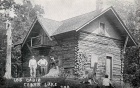
The clubhouse provided food and lodging, with entertainment aimed to draw the more privileged. In the earlier years the guests were huntsmen who could afford to travel many miles to the Lake of the Red Cedars.
A news item in 1901 told of the sale of the property to William Wright and of the large crowd attending a dance there: "All report having a good time."
The log building has been restored and remodeled many times through the decades and is now a private residence.
Stories were told by many old-timers about how a steam engine toppled into the quicksand, to be eventually swallowed out of sight. Safer and stronger tracks were rebuilt to the west of the old trestle, which was very close to the old plank road.
About 20 years later, in 1901, trains were slowed by another sink hole on the right-of-way north of Cedar Lake. It was called the "Klondike Sink Hole," where 2,500 railroad cars (400 daily) of rubbish were dumped in the apparently bottomless slough with little result.
The ground on both sides of the rails kept bulging up until it stood ten feet high above the surrounding area. In one day nine cars of old tires and 39 cars of dirt were used and the track was raised nearly two feet, only to fall back the next day.
It seemed a hopeless task until carload after carload of scrap from the Bedford stone company was dumped into the mire, and the project was eventually completed. The Monon freight trains and passenger trains could then safely move over the area of the deep hole.
An early newspaper reported the fishermen at Cedar Lake were plying hook and rod with proverbial patience and that the fish had been biting well. J.U. Spindler hooked a nice string of ten black bass the first of the week. But one fisherman told quite a story.
A fisherman by the name of Pat Duffy claimed that he caught a fish so large he could not pull it into his boat, so he hauled it to the shore. When drawn from the water, the lake level lowered so low that the steam launches were obliged to stay at their docks!
On December 17, 1857, Peter Lauerman, early settler of Western Prairie near Hanover Center (west of Cedar Lake), hitched his team of horses to a wagon load of oats, preparing for the long trip to Chicago, where he could get market price for his grain. In the evening he decided to stay overnight at a hotel at Blue Island, Illinois, and prepared to leave early the next morning.
Another hotel guest, a young man, asked permission to ride on Lauerman's wagon as far as the city. On the way, when Lauerman was kicking his feet against the wagon to warm them, the man, who was driving at the time, suddenly pulled his gun and fired, and Lauerman quickly died.
The 22-year-old man from Switzerland was soon captured, still driving his victim's wagon. He was convicted of murder and on April 20, 1858, was hanged as thousands of people watched.
Many young people rowed across the lake to Armour Town (northwest side) to trip the light fantastic that Saturday night. Reports stated that the evening was well enjoyed at Scheidler's Hall.
The Norwegian Club had its headquarters on the eastern shore of Cedar Lake. The group was invited to a party at the Don Driscoll home on Oakley Avenue in Lowell. They formed a hayrack party which passed through Lowell in the evening on their way to be royally entertained with a variety of amusements and sumptuous refreshments. Those present were Misses Johanna, Ella, Ragna, Oliva, Jennie, Rebecca and Ida Olsen, Harriet Petersen, and Messrs. N. Jennings, Albert Hege, Cecil Sigler, Carl Gragg, Loraine Dinwiddie, Ed Brownell, John and Justin Trealease.
Early in the 1900's, a petition that circulated at Cedar Lake to move the Paisley School House from its current location was presented to Superintendent Cooper. The building was said to be inconveniently located, owing to the fact that nearly all the students lived at a distance. A news item reported that the school house would be removed to Mr. Shaver's land near Einseles.
In the early days of boating, there was shortage of boats for a pleasure ride on the waters of Cedar Lake, when picnickers often waited a long time to go aboard leaky boats with four or five people aboard, some of them bailing to keep the small vessel afloat.
Early settler Adelbert Palmer sought to solve the problem and contracted pioneer Obadiah Taylor, an experienced ship builder, to build a schooner-style sailboat capable of carrying 100 passengers. The new vessel was christened in 1859 and called the "Young America," with room for 100 passengers. The cost to build it was $450. But the big boat sailed for only three seasons and was grounded at Cedar Point. In 1872 Samuel Love bought the "Lady of the Lake," a sailboat capable of carrying 30 passengers, at a cost of $135. About the same time, 15 new rowboats were available to fishermen and pleasure seekers near the Binyon Hotel.
In 1881, when the trains began to run, Captain Harper, who was experienced in sailing on Lake Michigan, brought his sailboat, the "Night Hawk," which could hold 20 passengers and cost $150, to the area of Cedar Point.
In 1882 Dr. Hunter had a more "modern" type boat. His steamboat held 40 persons and was built at a cost of $1,500. The dock was near his hotel at Meyer Manor. The Stanley brothers followed in 1883 with a smaller steamboat with capacity of 15, at a cost to build of $700.
In 1884 Wardell and Hinkley of Chicago were owners of a 25-passenger steamboat called the "Jesse," built for $1,200. Soon there were at least 200 crafts on Cedar Lake, including the "Dewey Line" which began with the first vessel called "Little Dewey," the first of several steam tour launches. These were later powered by gasoline engines.
There are no steamboats now, but the lake is churned by speeding water craft of many kinds, with many sleek sailboats gliding over the waves, and the old tour launches only a happy memory.
Return to Lowell History
Return to the "Pioneer History" A to Z Index Page
Contact referenc@lowellpl.lib.in.us