A giant boulder sits on an old Indian trail site in the Potawatomie Trail Park. That old trail leads to a quiet road-encircled mound near the lake. The surveyed size of the mound of today is about 70 feet by 76 feet. In the early days a foot path at the lowest level was narrow and used by the pioneers who began to arrive in 1834.
According to historical newspaper accounts in 1983, there were thirty-three known burials on the top of that unusual hill, with most marked by stone or wooden monuments. One of the markers is that of William Van Gorder, who was a U.S. Revolutionary war veteran. In 1976 a new marker was dedicated to the old soldier who lived at Cedar Lake during his retirement years. It was a privilege for the Old Timer to attend that dedication and to join the busy committee that was in charge. The new marker was donated by the Cedar Lake Veterans of Foreign Wars Auxiliary, as a U.S. Bicentennial project. The old soldier earned his pension for over 28 months as a private during the American Revolution.
Van Gorder applied for a pension transfer to Lake County on May 27, 1837, (the year the County began) : "where he now resides and where he intends to remain." A signed affidavit by his son-in-law Peder Barnard stated that Van Gorder was disabled and had been residing in Lake County since 1836.
In April 1839 Van Gorder purchased 14 acres along the shores of Cedar Lake, with the Mound Cemetery centering on his property. Rev. T.H. Ball wrote about the first (1837) white burial on the hill, the little daughter of Solomon Russell who drowned in an unfinished well. William Van Gorder was buried on the mound in 1840 at age 82.
Old records show that Van Gorder bought his 14 acres from Solomon Russell for $22. Russell had purchased 54.6 wooded land acres from the US government in 1838. Today the old "Indian Mound" is encircled by two roads named Washington and Truman Circle, the same that was marked in earlier days as a narrow ceremonial path usually found around similar historical mounds. When the burial ground was restored, the earliest stone visible was that of Mrs. Anna Sasse, dated 1840.
Surrounding land around the mound changed hands several times until 1856 when Henry Hack sold to Herman C. Beckman, and by 1858 it became the property of John H. Meyer. In 1867 his son John Meyer continued the family ownership until after 1900, when Otto Meyer claimed the land now known as Meyer Manor.
While used as farmland by the Meyer generations, the grassy, wooded pastureland fattened milk cows and hundreds of hogs fed themselves on acorns and wallowed in the muddy, marshy shoreline of the lake.
"Meyers and Beckman family burials were conducted in the old Mound Cemetery as Peter Geisen's horse-drawn hearse slowly weaved its way from family homes to the east side of the burial ground. The funeral procession there entered a long narrow uphill lane into the cemetery, a steep and tiring climb. Long thin gravestones, some plain, some elegant, (some long lost) with slender footstones were erected in quiet testimony." (Bea Horner)
The tall monument at the grave of Herman Beckman (1822-1894) was one of the finest and most costly in Lake County in that time.
Soon the lake area was bustling with the ice industry, there was a nearby handle factory, and the surrounding farms owned by John Schubert, Louis Herlitz and Otto Meyer were busy planting and harvesting. Before World War 1 a big subdivision move came to Cedar Lake and with it came one of the area's most widely known developers, Samuel C. Bartlett, son of a Peoria grain merchant. Samuel also considered grain as a career, but his interest turned to selling real estate.
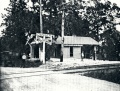
Bartlett had his real estate office in Chicago until 1913 when he built a cottage-sized building on the north shores of Cedar Lake, and where he processed all his real estate transactions, as customers enjoyed the cool screened porch, and were entertained in the nearby picnic grove. In that same year of 1913 he purchased the 14 acres called Meyer Manor and added 17 acres of Meyer Manor Terrace. He built his own railroad shelter at the northeast corner of nearby Armour Town, and furnished a bus, driven by Horace Blizzard, to deliver expected guests to his real estate office.
Bartlett assigned nine lots for business places with the cost of each building to be no less than $1000 for labor and material. Cottages, guaranteed to be finished 10 days after ordering, could cost no less than $500 and all must have two coats of paint. Only indoor chemical toilets were allowed; no tents were to be used; and roads, parks and beaches were private, with the small cottages on 25-foot lots, used then only in the summer time.
The first business place nearby was owned by John and Elizabeth Poltz, one of the early German families to come to Hanover Township in its early years. Their neat little store was located on what is now Lake Shore Drive, near one of the entrances of Meyer Manor. Their daughter Mabel and her husband William Cordrey took over the store that became well known as "Bill's Grocery"
By 1924 Marquette Road was cut into the Manor, the roads being named after streets in Chicago, and tall red brick pillars stood at the entrance. In 1928 the main stone road was resurfaced with concrete and the Monon Railroad had an overpass. This newly paved road caused the real estate business to prosper even more, and in 1929 a count of cars made by Jacob Gard showed a total of 690 cars per hour zipping by, all headed for Cedar Lake on a Sunday morning! And fashionable Meyer Manor contained their share of the traffic of those exciting years.
The neat little cottages, built with single siding and flooring, with wall board inside, were not built to retain winter heat, but they became nice summer homes with a minimum of care. Linoleum floors and brightly wallpapered walls brought color into the retreats. Samuel and Harriet Bartlett built their summer home near the mound on the north.
During the years those little cottages were built, homeowners were still watching funeral processions to the mound burial ground, which for years was kept up by the families of the departed.
Southeast of the mound John and Anna Adams owned a tall, two-story building where they offered a restaurant, tavern and sleeping quarters. Anna made steaming hot turtle soup served with homemade sausage and rye bread sandwiches for the low price of 25 cents.
Bartlett's dream slowed and dimmed at the time of the Great Depression, and many changes have taken place in the area of the Mound, the pioneer burial ground and the Meyer Manor subdivision through the decades. Today a trip through that northwest part of the Lake of the Red Cedars reveals a lot of progress with well-groomed homes and several busy business places nearby.
And perhaps in the bright moonlight of clear spring nights the ghost of Chief Abenaube can be seen at the mound burial ground as he slowly performs a blessing with a Ceremony of the Four Winds with his Kinnickinnic (tobacco and herbs) as he stands in memory of the days when the land was his favorite fishing and hunting grounds, land that he called "Meskwahoobis" (Red Cedar Lake).
Return to Lowell History
Return to the "Pioneer History" A to Z Index Page
Contact referenc@lowellpl.lib.in.us