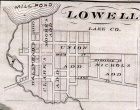
Old Lowell Map
Old Lowell Map
The space in the Star newspaper was largely devoted to booming the proposed railroad, and editor Beebe put up some strong arguments in behalf of the enterprise. His whole energy seemed to have been concentrated on securing the coveted prize, but after five years booming he threw up the sponge and moved the Star to Crown Point. The date to vote on the proposition to levy a special tax to aid the proposed railroad was set for July 15 (1872), and the space in the paper was largely urging the voters to vote yes on the proposition. There was quite a lengthy article in the paper from the pen of Hiram Wason.
In August of 1872 a gang of graders began work on the proposed railway between Rensselaer and Francesville and plans for the railroad to go through the town of Lowell were being made.
In the June 1, 1872, Lowell Star there was news about a citizens' meeting to decide to celebrate the Fourth of July in the Town of Lowell. J. W. Viant was president of the meeting and committees were made up of many of Lowell's pioneer businessmen . George Mee, owner of the Union House Hotel, announced that he would erect a large "bowery" that would accommodate thirty couples on the Fourth.
By June 15 the celebration committees had been revised, with many more local business men and prominent ladies added to the list. "The Fourth of July committees were sweating night and day to make the coming celebration the biggest thing of its kind ever attempted in northern Indiana."
From the July 6, 1872, paper: "The Fourth of July celebration was one of the memorable events in the history of Lowell. The procession, headed by the Momence band and gorgeous chariot with the beautiful Goddess of Liberty surrounded by the Zone of State was a beautiful sight. John Donch was chief marshal and H. Lepine, C.L. Templeton and Ed Demond, assistants. The glee club, under the supervision of U.J. Fry, was a prominent feature. Prof. McCafferty failed to arrive and the Declaration of Independence was read by H. Bonham who was commander in general of the celebration. The orators were Major Calkins and Congressman Jasper Packard. The beauty and loveliness of Lowell was well represented. Miss Eliza Driscoll was the favored one chosen to represent the Goddess of Liberty. Her part was a beautiful feature of the occasion and was carried out with exquisite grace.
"Several hundred teams [horses] were counted in Lowell on the Fourth, and the crowd was estimated at 7,000 by General Packard. In addition to the local attraction, Hamilton Brothers Circus and Indian Show was a drawing card. The circus people joined the procession as it marched from town to the 'old speakers ground' east of the Methodist Church and with their large band and Indians added materially to this feature of the day's program." [The 1870 Methodist Church was at the northwest corner of Burnham and Main Streets -- the "speakers ground" could have been a natural amphitheatre on the hilly area near Kankakee Street.]
Many other interesting news items were featured in the 1872 newspaper: The mill pond, the glory of the town, was full of fish and the anglers were catching big strings. The pond swarmed with bathers nightly.
Mrs. McCain lectured on "Spiritualism" in the Union Hotel hall.
Marvin Warner, owing to ill health, advertised his store at Orchard Grove for sale. [This general store and post office was purchased by pioneer Jeremiah Kenney. Another history site shows that Kenney bought it from DeForest Warner.]
The Presbyterians had just completed a very neat little church in West Creek.
William Sigler was having a new tin roof put on his large store building. [His general store was at the site of the restaurant building at Commercial Ave. and Wall Street. It burned in the big fire of 1898.]
Lowell suffered its first loss by fire Sunday, June 15, 1872, when flames devoured the livery stable of Daniel Lynch and the blacksmith and wagon shop of C.M. Blachley, located at the southeast corner of the public square [corner of Union and Franklin Streets; Cornelius M. Blachley was murdered by John Myers in 1877].
The wolves played havoc with Jerry Kenney's sheep at Orchard Grove.
Prairie chickens were numerous and the nimrods were impatiently waiting for the open season. On July 29th, 1872, the thermometer reached 102 in the shade.
Several "titled noblemen" consisting of Lord Parker and Captain Blake purchased several acres of island and swamp land in the Kankakee river region southwest of Lowell and began the erection of elaborate building thereon. It was their intention to establish a hunting reserve and engage in extensively breeding fine stock. [This was the site of the well-known Cumberland Lodge.] Wellington Clark announced his intention to move from his farm [West Creek] to Crown Point. [His home, called the "Old Homestead," on Court Street in Crown Point is now being restored.] J. W. Viant advertised as follows: 10 pounds good brown or 8 pounds white cane sugar, $1; coffee, 7 pounds for $1; salt, per barrel, $2.50.
The receipts of the County Fair were $800.
Hunters were bagging a good many prairie chickens
A petition was being circulated praying the state legislature to repeal the Kankakee Valley drainage law.
A game hunt and supper was planned. The supper to be prepared by Mrs. Mee at the Union House Hotel. [The old hotel, circa 1860, is still standing on west Commercial Ave., first block west of the railroad.]
Water was so scarce many farmers drove their stock two and three miles to water.
Teaming between Lowell and Chicago was a profitable business, both to merchants and teamsters, in spite of the five railroads in Lake County.
Many more 1872 news items can be found at the Lowell Public Library web site -- http://www.lowellpl.lib.in.us/
Return to Lowell History
Return to the "Pioneer History" A to Z Index Page
Contact referenc@lowellpl.lib.in.us