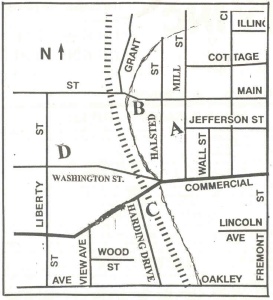
A - site of the frame grist mill built by Melvin Halsted in 1853. A block-long wooden trough on posts carried the rushing water from the Main Street dam to operate the mill, west of Mill Street at Jefferson Street. The site presently holds the former Palo Theatre building.
Halsted came to Lake County from Ohio in 1845 and farmed in West Creek Township until 1848, when he moved his family into a deserted log cabin near the present railroad depot in Lowell. Recognizing the value of Cedar Creek as a possible source of power, he rapidly restored an old dam and saw mill and had the saw mill running that same year of 1848.
Melvin Halsted wrote in his autobiography: "Arrive home [from California Gold Rush] in August [1852], bought out Haskin's [Orlando E., a relative] interest in the property and erected a flour mill, and got it running January, 1853."
Water from the dam near the early saw mill on Main Street rushed down a long wooden trough to turn the water wheel powering the mill on the west side of Mill Street at Jefferson St., the site of the present old Palo Theatre building.
The wooden trough was a block long. This first grist mill, of frame construction, was in operation until 1867 when it "wore out."
This mill, powered by water directly from the nearby dam [which held back a large pond covering many acres], was originally built for a woolen factory which operated for a short time, and only wool "carding" [cleaning by hand or machine] was done until the building was remodeled as a grist mill and the machinery from the older mill on Main Street was installed.
The three-story brick building with a mansard roof was pictured on a 1912 post card, but in the 1920's, when the Old Timer joined his young friends swimming in the creek below the old dam site, there were no remnants of the old building to be seen. Some other old timers may remember running off the high bank, hoping that they would go into the water instead of hitting the small beach below.
Leonard Keilman, a Dyer businessman, was a longtime partner (John M. Dubreuil died in 1892) in the Dubreuil-Keilman Co. and, in later years, was a partner of John Kimmet. Keilman was born in Germany in 1833 and came to America in 1840 with his parents, who first settled in Ohio, then to Lake County in 1844.
John Kimmet, son-in-law of Leonard Keilman, was born in Ohio in 1856, taught school in Ohio and Dyer, then became the first bookkeeper of the mill business in Lowell in 1881, served as vice president of the State National Bank of Lowell, and became treasurer of the Three Creeks Monument Association, formed for the erection of the 1905 veterans' monument on Lowell's square.
His large frame home still stands at the south end of South Fremont Street.
Edward Wood, a longtime employee at the mill, lived in the firm's residence high on a hill across the present Harding Drive. The hill is long gone, but the house still stands where it was moved to at the corner of Harding Drive and Oakley Avenue. He learned his trade at his family's mill at Deep River, now restored at Deep River Lake County Park.
In 1902 the company added a large lumber shed where all types of building materials were sold, including concrete blocks.
From the "Pioneer History" column in March 1986 in the Lowell Tribune: "In the 1920's the Old Timer admits that he and a few of his friends ignored the posted "Condemned" signs and carefully explored the dark, spooky building with its gray dust and vermin, and climbed up the squeaking steps to the top of the mill."
This dangerous playground, the old flour mill, was torn down in 1927.
Nichols, the youngest son of pioneer Horatio N. Nichols (1818-1897), worked with his father and brother in the hay and grain business in Lowell from 1881 to 1886, then left to work in Chicago, Illinois.
He returned to the Lowell business in 1891, built the elevator near the large hay barn, and added a four-level brick building in 1904. He sold the elevator in 1917 when he moved to California, where he was in the ice business until his retirement in 1937. He died in California in 1942, nearly 81 years of age.
In 1917 the mill was purchased by three farmers: Herbert Rieke, George Tyler and Bernard Carlin, and the name was changed to "Lowell Grain and Hay Company."
Later, Tyler bought out his partners and, after his passing, his wife Bertha and her brother George Regnier operated the business.
In about 1959 the firm was sold to Mr. and Mrs. Lester Holley, who were there until the 1970's, when the site was sold to Vincent Zunica, who planned a business complex.
In 1994 the Old Timer joined a small crowd of onlookers when most of the old buildings disappeared into the dust as modern heavy equipment began the demolition. Clouds of bats were forced to fly to new abodes.
The old mill residence still stands on the corner, as part of an office building, while the red hay barn, moved from the original site close to Liberty Street, is now on the east border of the property.
Return to Lowell History
Return to the "Pioneer History" A to Z Index Page
Contact referenc@lowellpl.lib.in.us