

Pioneer History by Richard C. Schmal
The Keilman-Kimmet Flour Mill
(from the Mar. 26, 1986, Lowell Tribune, page 17)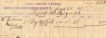 1892 shipping bill |
 exterior, 1906 |
 interior, 1906 |
During 1880 and 1881, at the time the railroad was under construction in the Town of Lowell, an important commercial building was also erected near the railroad right-of-way.
The DuBreuil-Keilman Elevator and Planing Mill came into existence during those years, located on the west side of the Monon Tracks near the Lowell Depot. The Hardings, Inc. storage building now occupies a part of the site. The original building was 32'-by-60' in size, 70 feet high, and had a capacity of 60,000 bushels. The large smokestack was a clue to its steampowered system.
In a story in a 1952 Lowell Centennial publication, it was assumed that the mill on Washington St., near the Lowell Post Office, was the Dubreuil-Keilman mill. This error was also carried in the Lowell U.S. Bi-Centennial Book of 1976.
But the mill on Washington St. was actually the Nichols Elevator, in later years known as the Lowell Grain and Hay Co. Still standing near Lowell's Liberty Park, it is no longer in operation, and its sidetrack has been gone for several years. [Note from 2001: It was demolished a few years ago.]
Leonard Keilman, a Dyer businessman, was a partner for many years in the Dubreuil-Keilman Co., and later with John Kimmet. Keilman was born in Germany in May, 1833, the son of Henry and Elizabeth Keilman, who immigrated to America in 1840. The family first settled in Ohio, then came to Lake County in 1844.
John A. Kimmet was the early bookkeeper at the elevator, beginning in 1881. He was born in a log cabin at Seneca County, Ohio, in 1856. He obtained a good education at Heidelberg College, Ohio; St. Vincent College in Pennsylvania; and St. Francis College near Milwaukee, Wis. and was a teacher for four years in Ohio. He came to Dyer in 1878, where he was principal of the high school there for two years, until he joined the milling firm and moved to Lowell.
In 1880, he married Maggie Keilman, daughter of Leonard Keilman, the miller. In 1892, when Keilman's partner John N. Dubreuil passed away, Kimmet purchased the half interest and became a partner in the firm. The company name was then changed to Keilman-Kimmet.
Kimmet also became vice president of the State National Bank of Lowell, and was a director of the First National Bank of Dyer.
In 1897 he was active in the building of the second St. Edward Catholic Church building . This was a frame building with a steeple, facing west on Castle St. It burned in 1914 and was replaced by the brick building that now houses a nursing home on Burnham St.
Kimmet was treasurer of the Three Creeks Monument Assn., an organization formed for the erection of the monument in Lowell's public square, dedicated in 1905 to the memory of participants in four wars. He owned twenty acres of land in the south central part of the Town of Lowell.
Edward E. Wood, a longtime employee of the mill, was born at Woodvale in 1856, one of eight children of Nathan Wood and Rebecca (Rundle) Wood. Edward's grandparents were John Wood, born 1800, and Hannah E. (Pattee) Wood, born 1802. They were the founders of the Deep River Mill at Woodvale in Ross Township, Lake County, now a part of the Deep River Lake County Park. The saw mill and grist mill there, built in 1837 and 1838, were said to be the first in Lake County.
Nathan Wood had purchased the mill from his family in the 1850's and was postmaster at Deep River from 1844 to 1881. He was a partner with his brother, George, for four years.
Edward Wood learned the milling trade at the family business, then moved to Lowell to work for the Dubreuil-Keilman firm in about 1889, when a grist mill was added. The capacity was 75 barrels of flour per day. He and his wife, Kate Small Wood, 1867-1943, lived in a home just west of the mill on the present Globe Drive.
The house is still standing, although it has been moved south and around the corner onto Oakley Ave. Wood died suddenly in December 1936, at age 80, at his retirement home on West Commercial Ave. The Old Timer remembers him as a very kind man.
In 1902, a large lumber shed was added to the Keilman-Kimmet firm, which then sold grain, tile, brick, cement, lumber, glass, paints and all kinds of building materials. Shipments were made to Chicago, Chicago Heights, Frankfort, Madison, and many other points in all directions.
In 1909, the following advertisement appeared in a local publication: "Keilman-Kimmet Flour Mill, Leonard Keilman, President, and J.L. Keilman, Vice President, and John A. Kimmet, Secretary, Treasure and Manager. Monon Tracks."
In the 1920's the Old Timer admits that he and his friends ignored the posted "Condemned" signs and carefully explored the dark, spooky old building with its gray dust and vermin, climbing up the squeaking steps to the top of the mill.
This dangerous playground, the Keilman-Kimmet Flour Mill, was torn down in 1927.
Return to Lowell History
Return to the "Pioneer History" A to Z Index Page