

Pioneer History by Richard C. Schmal
Did you know that. . . (about the Kankakee River)
(from the Mar. 25, 2003, Lowell Tribune, page 5)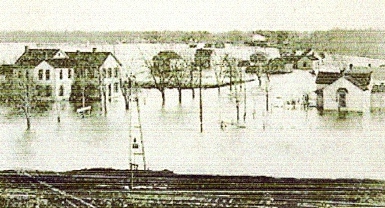
* the Kankakee River rises from springs and swamp lands near the village of Crumstown, a few miles southwest of South Bend, Indiana?
* according to old reports in 1884, the Kankakee River was a slow, sluggish stream with a fall of one foot to one-and-a-half feet to the mile while curving through the state of Indiana?
* the Kankakee River flows southwest to Aroma Park, Illinois, where it turns northwest toward Wilmington, Illinois, then meets the Illinois River? It flows for 59 miles in Illinois.
* the French explorer LaSalle (1643-1687) and his men paddled their canoes on the river in 1679? The hardy group followed the course to the Illinois River and on to Lake Peoria where they constructed a new outpost. The Three Creeks Historical Association sponsored a fund- raiser for part of the reenactment of that famous trip from August 1976 to April 1977.
* the Old Timer feels fortunate to have seen the old river before huge dredges destroyed some of the natural beauty? Well remembered are the flower-covered sand bars on the many oxbow curves of the stream.
* the course was shortened by 80 miles in Lake and Porter counties when the big machines finished their work? The dredged stream was then named "Marble Power Ditch," and the largest swamp lands in the state of Indiana became rich farm acreage.
* after the river dredging began in 1917, bones of ancient animals were discovered? Mastodon, sabre-tooth tigers, giant beavers, amd a species of large elk were among them.
* French explorer LaSalle wrote in his journal of capturing a buffalo along the Kankakee River. In December 1679 he wrote that large herds had passed going southward.
* several French traders were known to be living along the stream when the pioneers arrived?
* Charles Kenney visited a man named Laslie and his Indian wife in 1839 at his trading post on Big White Oak Island, to the south of the community of Orchard Grove? Other known French traders were James Betrand and Louis LaVoire.
* the islands in the swamp were covered with heavy growth of timber early in the 1800's? But as many as 100 loads of logs were seen daily, moving slowly northward on very cold winter days.
* early settlers were forced to travel many miles out of their way to cross the river? Some crossed on the rapids at Momence, Illinois, and in dryer weather, the ford at Baums Bridge near Kouts. It burned the following year, and a ferry boat was used.
* in 1875 17-year-old Max Ahlgrim was given the responsibility of supervising a load of lumber and furnishings for the family home to be erected in Shelby? He hired a steamboat at Momence and reported that he had the time of his life as the little steamboat, the "Morning Star," made waves as it went against the current eastward. Max was well-known in Shelby for his "Ahlgrim's Park," now the riverside subdivision "Shady Shores."
* the Kankakee River once divided Newton County? An old 1836 map, now on display at the hisoric Halsted House Museum, shows the Kankakee River dividing Newton County. That changed when Lake County was created in 1837.
* the famous General Lew Wallace had this to say about the Kankakee: "Never, in all my world travels, have I seen a more perfect spot [Baum's Bridge], nor a more tantalizing river."? The general from Indiana, also a well-known novelist, spent several years in the historical Kouts area, at the site of an early ford at the stream.
* Rol Gordon is the "Paul Bunyan" of the Kankakee Valley? It was told that he was a huge man who wore buckskin clothes and told tall tales -- stories about man-eating turtles and fish with scales bigger than silver dollars! Gordon really lived in the river valley and wrote and told his stories for decades, and if you are near the Kankakee and listen quietly in the wind, perhaps you can hear old Rol telling tall tales once again.
* Trapper George Cole had many stories to tell? Some of his tales can be found in the Sept. 1991 "Pioneer History" column at the Lowell Public Library web site. In all, about 278 "Pioneer History stories can be found there, as well as the interesting Lowell photo album, biographies, and Lowell area history.
* Rev. Timothy Ball, pioneer preacher and historian, described some of the beauty of the Kankakee River? "Thousands of acres of swaying reeds, fluttering flags [iris], clumps of wild rice, lily pads, green moss, black mire, misty haze and miry depths."
* 6,000 acres in Lake County were once covered with wetlands? In all, 600,000 acres in seven Indiana counties were wetlands.
* the fame of the Kankakee Marsh went to the far corners of the globe? The almost unbelievalbe abundance of wild fowl, fur bearing animals and fish made it a popular mecca for the hunter, trapper and fisherman.
* the prominet islands in the river valley in Lakde County were Beach Ridge, Red Oak, Warner, Grape, Fuller, Ridge, Brownell, Lalley, Curve, Skunk, Long White Oak, South Island and Wheeler Island? Most were once covered with a heavy growth of timber.
* the Kankakee River has a main elevation of 90 feet above Lake Michigan? It is also 160 feet above the waters of the Wabash River, as written in a story by Rev. T.H. Ball in 1884. The elevation above sea level for Lake Michigan is now listed as 577 feet.
* one trapper claimed to have trapped 1,540 muskrats in 1884, the year when a total of 30,000 were caught, along with several hundred mink. Ducks by the wagon load were seen leaving the area of the hunting lodges in the Kankakee Valley. In all, 550 square miles in the state of Indiana are now covered with water.
* the Kankakee River is unique in that there is an Indian portage on one end and an atomic age power plant at the other, and between those two points many interesting and exciting tales.
Return to Lowell History
Return to the "Pioneer History" A to Z Index Page