

Lowell High School History
 Lowell High School Building, 1906 |
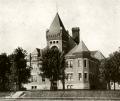 Lowell High School Building, 1913 |
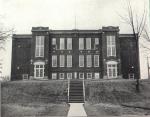 Lowell High School, 1916 |
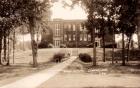 Lowell High School, 1920's |
 Lowell High School, 1920's |
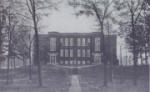 Lowell High School, 1922 |
The following comes from a 1913 book entitled Educational Report: Lake County Schools, pages 33-34:
Lowell High School
By Supt. A.T. ElliottIn arranging the course of study for our high school, local conditions and needs have been kept constantly in mind. It is apparent that a course of study suitable to meet the conditions in our high school may not be suitable for other schools. It is true college entrance requirements have been kept in mind, so that those desiring to attend college will receive proper recognition. Aside from the college entrance requirements our course has been made very flexible by providing for elective subjects.
Realizing the need of industrial education, courses in sewing, household economics, and agriculture have been added. As a great number of our pupils come from the rural districts, special attention has been given to the arrangement of a three years' course in agriculture.
The first year is devoted to the study of agricultural botany, which treats of the identification and classification of the common plants; the method of propagation and improvement; the plant and animal enemies; the rate of increase and growth of noxious weeds; the time and manner of destroying the same, etc.
The second year is devoted to the study of soils, field crops, fruit growing and vegetable gardening.
The study of soils treats of the origin, formation, composition, and classification of the soils in the community; their physical properties and methods of treatment in relation to their behavior toward moisture, air and heat; and the improvement of soils and the maintenance of soil fertility.
The study of farm crops treats of corn judging; simple germination and purity tests of seeds; the study and identification of all kinds of seeds; and a study of the bulletins put out by the state experiment station and the U.S. Department of Agriculture.
The study of vegetable gardening treats of the study of varieties and management of vegetables; the home garden; and the construction and management of hotbeds and cold frames.
The study of fruit growing treats of the principles of plant propagation; laboratory work in grafting, layering, cutting and pruning; care and cultivation of fruits for home and market; and means of destroying insects and fungus diseases. The third year is devoted to the study of live stock, dairying, poultry and the principles of feeding.
The study of live stock treats of the breeds of horses, cattle, sheep and swine; the scoring and judging of individuals; and the methods of improving the live stock upon the farm.
The principles of feeding is a study of the classes of animal feeds; the function of each in the animal's body; the study of bulletins put out by different stations; and the compounding of balanced rations.
The study of poultry treats of the origin and history of the breeds; winter and summer care of poultry; feeding for growth and egg production; and the treatment of diseases and methods of housing poultry.
The study of dairying treats of the improvement of the dairy herd; the judging of the dairy cow; the testing of milk for butter fat; and the care of milk on the farm
The purpose of this course as outlined above is to make agriculture comparable in extent and thoroughness with the courses in physics, botany, history, literature and other subjects. The subject is not one that can be memorized or even acquired in the ordinary methods of school study; it relates itself to the actual work and business of the community in such a way as will develop the students' judgment of affairs and conditions. We hope by the introduction of this course to bring the school in touch with the daily life of the community, and to lead more boys to choose agriculture as a profession.
We now have forty-five pupils taking the work and hope to enlarge and strengthen the course for next year by the addition of more laboratory equipment.
From the Lowell Tribune, August 2, 1928, page 1. Also found in the Local History files at Lowell Public Library under LH: Schools--Early High School:
FROM PAST TO THE PRESENT
- HISTORICAL SKETCH OF THE LOWELL DISTRICT HIGH SCHOOL
- By C.A. Grayson
- The first school building in Lowell was located in the old town near the present site of the Clark Monument Works, east of the cemetery. But when Melvin A. Halsted, who is regarded as the founder of Lowell, began the new town on Cedar Creek, he built a one story, one room brick school house on a hill which was on Lot 1. of Clark's Addition. This lot is now occupied by Trump's restaurant, Pixley's jewelry store, Victor K. Roberts' law office, and E.M. Berg's clothing store. Soon this building proved inadequate and a frame house was used as an annex. This house was built by John Lynch. It stood back of the livery stable and later was moved to the corner and has been remodeled into the Nicholas Minninger bungalow. During the 60's the overflow of the school was cared for in the upper hall of the Mee hotel. The upper floor of this hotel was a large hall in which were held school by day and dances by night. The Mee hotel was located on the site of the Mrs. L. Davis residence which is now occupied by Dr. and Mrs. G.W. Bardens. The hotel was later destroyed by fire.
- The town of Lowell grew so that the one room school was so inadequate that in the year 1862 a new building was erected on the corner of Main and Union streets where the present Grade school now stands. This building [was] also erected by Melvin A. Halstead, but this time as Township Trustee. According to Rev. T.H. Ball in his "History of Lake County--1904": "In 1872 Lowell had the largest and the best school building in the county." It was a two story, four room brick structure which cost, including furniture, the sum of $8,000.00. Although this building enjoyed the distinction of being the largest in the county, it soon became inadequate and a one room frame building was erected on the northeast corner of the school ground.
- In 1868 the town of Lowell was incorporated and the schools passed from the Township Trustee to the Board of Trustees of the town, composed of three members.
- It was in this brick building, erected in 1862, that the Lowell High school had its beginning. The first High school class was organized by G.A. Hawkins for the school year of 1886-87. At first the course was only for three years and all classes were taught by one teacher, the superintendent and principal. The first class to be graduated from the three year course was the Class of 1890. In 1896 the course was extended to four years and the school received its commission in December, 1896. The first class to graduate from the school, with a commission, was composed of only one pupil, Will Davis, who had been a member of the Class of 1896 as a graduate of the three year course. The commission was secured by W.M. Sheets, Superintendent, and George W. Waters, W.L. Handley and E.R. Bacon as the Board of Education. The inspection for the commission was made by J.N. Study, superintendent of schools of Fort Wayne. With the beginning of the four year course the number of teachers in the High school was increased to three, being W.M. Sheets, Superintendent; Walter Sanger, Principal, and Luella Fuller, instructor.
- As preparation for securing a commission the brick building of 1862 was wrecked and a new two story, eight room brick building was erected on the same site in 1896. This building is the present Grade school building. That year the beginning of school was delayed until the new building was completed, which was in December, 1896. This school soon outgrew this building and a one room brick building was erected on the northeast corner of the school lot. [See correction at the end of this article.]
- The school continued to grow.
- The Board of Trustees of the School Town of Lowell were Starr A. Brownell, George J. Hoevet, and Dr. John W. Iddings. James Black was Trustee of Cedar Creek township and the Advisory Board was F.G. Carstens, L.E. McNay and Samuel Sirois. Henry Hathaway was Trustee of West Creek township and Martin Musbach, William Bruce and B.F. Carlin constituted the Advisory Board.
- At this joint meeting held March 6, 1914, it was agreed: "That a new School District be determined and constituted, and that said new District shall be known as a High School District, and shall include the Town of Lowell, in its entirety, and Districts Five (5) and Six (6) and also the properties of the Chicago, Indiana & Southern Railroad Company, the Chicago, Indianapolis and Louisville Railroad Company, and the Postal Telegraph and Cable Company, as portions of Cedar Creek township, and Districts Seven (7), Nine (9), and Twelve (12) and also the properties of the Chicago, Indiana and Southern Railroad Company, the Indiana Truck Farm Company, the Indiana Telephone Company, the Western Union Telegraph Company and the Pullman Company, as portions of West Creek township, and that the new building shall be located in the town of Lowell, at the site of the East Eight (8) acres of the South twenty-six (26) acres of the Northwest Quarter (NW1-4) of the Northwest Quarter (NW1-4) of Section Twenty-six (26), Township Thirty-three (33) North, Range Nine (9) West of the Second P.M., in Lake County, Indiana; that the cost of the new building be approximately $30,000.00. That the cost of construction of the new building and maintenance of the school be borne by the three municipalities in the following proportions: Cedar Creek Township, 11 1/2-30s; West Creek Twonship, 11 1/2-30s; Town of Lowell, 7-30s.
- That the control of the joint High school building shall be vested in a Board of Governors upon which all three corporations shall have equal representation.
- April 14 the sale of the bonds bearing 4 1/2 per cent interest, was authorized, and they were advertised to sell July 10. But due to the war like conditions in Europe no bids were received. The Boards then held special meetings and raised the interest rate to 5 per cent. The bonds were then sold October 17, 1914.
- In the meantime the contract for the building had been let to J.H. McClay of Hammond, and work was being carried on. The building was not completed and school begun in it until January, 1916. The architect was Mr. Erickson, of Gary. The Superintendent of the school was A.T. Elliott.
- Later by an Act of the General Assembly for the year 1917 (Chapter 24), approved February 24, 1917, the burdens of the schools were to be borne by the three corporations in proportion to the assessed property valuation in each respectively. Thereafter the joint High school district became the Town of Lowell and the two townships of Cedar Creek and West Creek, each in its entirety. Thereupon the High school at Shelby in Cedar Creek township was merged with the Lowell District High school in the fall of 1920.
- In December 1926 and January 1927 joint meetings of the voters of the town of Lowell and Cedar Creek township were held to consider the abandonment of the School Town of Lowell. January 15, 1927 an election in each of these corporations was held and by a large majority the voters in both gave their consent for the abandonment of the School Town of Lowell. February 2, 1927 the school of the Town of Lowell was deeded to Cedar Creek township. Thereafter the joint High school has been under the control of the two townships, and County Superintendent A.E. Condon became Superintendent of the joint High school.
- May 9, 1927, a storm swept over Lowell about three o'clock in the morning and blew off the roof of the High school building. School was continued however, in the basement and lower floor.
- Within a few years the school had grown so that the new building was inadequate, and an agitation for an addition to the building was begun. After much agitation by patrons of the school and school officials and after repeated recommendations by the State High School Inspector, a joint meeting of the Trustees and Advisory Boards of Cedar Creek and West Creek Townships was held October 1927 in the office of the Trustee of West Creek Township. Here it was agreed that an addition was much needed and should be erected, and William Tatman was instructed to consult with the Principal, Cecil A. Grayson as to the needs of the school and to prepare a sketch of an addition that would take care of these needs. This, Mr. Tatman did and his sketch was accepted at till the congestion became so great that it was decided to build another building which was to house the High school only. March 6, 1914 at 7:30 p.m. the Advisory Boards of West Creek and Cedar Creek townships and the Town of Lowell met in joint session, "to confer with each other, and to consider the question of the construction of a hew High school building in a new school district, to be determined and created by the joint meeting. Such building to be constructed and maintained jointly by the municipalities herein mentioned. It is the further purpose of said meeting to determine the territory to be included in the said new district, and to assign to each municipality its legal portion of the total cost of said High school, and to consider the question of issuing bonds."
- . . . The Trustees were Merritt W. Kelsey, of Cedar Creek township, and Harry P. Simms, of West Creek township. The Advisory Boards were: Henry Carstens, Herbert F. Rieke and George Foster, of Cedar Creek township, and John Stuppy, Boyd Wason and James Little, of West Creek township. This joint meeting ordered Mr. Tatman to draw architectural plans for the new addition. This he did. The plans were certified to by Kopf and Deery, Indianapolis, who were employed as architects, and approved by the State Boards.
A CORRECTION [from The Lowell Tribune, Aug. 9, 1929]
- When C.W. Mulinex, of LaBelle, Mo., was here on Monday he informed us that there was an error in the history of the Lowell school in that the school building erected on the site of the present grade school building and torn down in 1896, was erected in 1868, and that Harvey Wiley at one time head of the Pure Food Department for the U.S. Government, was the first teacher in this building. Mr. Mulinex was just a boy at that time and attended school in the building.
From the Lowell Tribune, Feb. 16, 1950. Also found in the Local History files at Lowell Public Library under LH: Schools--High School:
- HISTORY OF L.H.S.
- (By Roland Hoffman)
- In the year 1892, the town of Lowell had a high school in the four upper rooms of Lowell's grade school today. The four lower rooms were for the grade school. At the same time Cedar Lake and Shelby had their own high schools. These high schools at that time were called two-year high schools. Imagine finishing high school in two years. As time went on the town of Lowell saw the need of expanding their education system so they built a shack behind the grade school which was called the "doghouse" (no explanation). This was attended by quite a few students. It has been said three students were in high school one year.
- As Lowell started to become a big city they saw the need of a city high school. In 1914 a nine room school was built where the school now stands, In 1928 the enrollment was expanding to as many as 250 students so they added the gym, cafeteria, science, and a small study hall. In 1928 West and Cedar Creek townships made Lowell a consolidated school as it still remains. One bus from Shelby brought students to attend.
- The enrollment still expanding to 400 in 1941, the newest edition was built. The shop, study hall and music room is called the 41 addition. Still expanding Lowell now has 433 students.
For more information, go to Lowell High School Graduates -- 1890-1916
Return to Lowell History