

Pioneer History by Richard C. Schmal
Lowell as a Business Town, 1908
(from the Feb. 26, 2002, Lowell Tribune, page 14)William H. Taft was running for President of the United States on August 20, 1908, when publishers H.H. Ragon and L.W. Ragon of The Lowell Tribune featured a lengthy news article about Lowell "as a progressive business town."
"Lowell, in spite of many adverse circumstances, has grown to be an unrivaled market for what farmers have to sell," the story read. "Fine elevators and other advantages render this locality especially adapted to the interests of farmers. It is an excellent shipping point, having the competitive opportunities of New York Central lines two miles westerly at North Hayden, and the Monon Route in town. Hay, grain, stock, butter, eggs, everything in fact at Lowell finds a ready market. No one can gain anything by sending their money to catalog houses when better goods for the same money may be had in Lowell.
"Lowell has many good dealers and among them we write up a few who are well stocked up for early fall trade:"
S.M. LaRue
"...excels in pleasing the people at his large double General Department Store, Here can be had all the latest and best dry goods, clothing, furnishing goods, hats, caps, shoes, notions, carpets, linoleums, curtains, crockery, glassware, groceries, etc. At this store the proprietor sells for cash and pays cash for what he buys."
The LaRue store was one of the earliest in the old Opera House building at the northeast corner of Mill St. and Commercial Avenue in Lowell, destroyed by fire in 1976.
George J. Hoevet
"...dealer in general merchandise, has a department store which is in every way a gratifying establishment to patronize. There are bargains to be had in each subdivision of this large double store and it is worth your driving many miles on purpose to purchase goods here. The general advantages of this department store are appreciated by all who see this large and varied stock."
The Hoevet store was sold to the Lynch Bros. in 1916, then to the Spindler Company in 1830, until it was sold to Sears. Several smaller stores and offices have been in the building at 418-420-422 East Commercial Avenue, now the home of an office supply store, restaurant and proposed tavern.
Lowell Plumbing and Supply Company
"...of which C.A. Gorball is the able manager, maintains a supply of everything in the line of sanitary plumbing supplies. Gas fittings, tubing and capping, lightning rods, well material, bath tubs and Quaker furniture. They do all kinds of sheet metal roofing, and sell windmills and tanks. Consult the reliable manager."
Gorball's firm was in a large frame building that once stood next door (west) of the present downtown hardware store. The old building was moved decades ago south to the alley, where it stood for many years as a junk store near the creek.
The State National Bank
"...with a capitol stock of $50,000, is an institution in which people take pride for its satisfactory record of usefulness, conservative growth and prosperity. It was founded in 1901, being a consolidation of the State Bank of Lowell and the First National Bank. This is an institution which assists greatly in developing the town and the surrounding Country."
The State Bank began in 1891 in the building now occupied by a gift shop, was moved to a new building in 1900, and was taken over by the Lowell National Bank in 1930. The 1900 building now houses a restaurtant-antique shop at 313 East Commercial Avenue, where the old bank alarm can still be seen above the large front window.
Burnham Brothers
"...well known as hardware dealers, now have their store supplied with the best assortments for seasonable trade; summer cook stoves, utensils and metallic goods, builders' and mechanics' hardware, cutlery and various supplies of a first-class hardware."
This hardware store was at what is now a vacuum cleaner sales and service store in the 400 block of East Commercial Avenue. In 1918, soon after the Burnham brothers sold out, Fred Schmal (the Old Timer's father) became the owner of the store until his retirement in 1934. The building has been the site of the Lowell License Bureau as well as the Lowell Post Office.
George Wilson
"...who has been here for over 12 years, is known by everybody as a meritorious iron smith, who has a well-equipped blacksmith shop here. He does horse shoeing in a manner that pleases and protects cracked hoofs. Excellent plow work is done. Automobiles are repaired and he sells the celebrated Jackson Automobiles (manufactured in Jackson, Michigan)."
Wilson's shop, combining work for both horses and autos, was at the large building to the south of the present barber shop on Mill Street.
Sam H. Price
"...a first-rate harness and horse furnishing store here. He sells superior team harness, single harness, whips, robes, blankets, nets and lap dusters, Has a good manufacturing and repair department. People around this town respect him greatly as a gentleman of integrity and probity."
In 1908 his harness shop was at the northwest corner of Commercial and Mill; the building moved long ago to the American Legion grounds to be used as a scout hut. It was moved again to another location on the grounds to make way for an addition to the Legion building. Later the Petrie Harness shop was, for decades, at the northeast corner of Commercial Avenue and Halsted Street, first in a small frame building and later in the brick building now housing an antique shop. The small building still exists on a farm north of Lowell.
Lena Kimmet
"...a tasteful and up-to-date milliner, has opportunities that are excellent in ladies hats. She is well posted in styles and had excellent taste and adaptability, with liberal prices, within the reach of all. She also does dressmaking during the intervals between the busy seasons."
This hat shop was located in the building vacated a few years before by the first bank in the Town of Lowell, in the building next to the old town hall. Later Martha Smith purchased the business and was the well known milliner there for many decades.
George W. Heilig
"...Proprietor of a first-class bakery, has a fine fresh stock of bread from the oven. Choice pies and cakes always fresh. The ice cream parlors are very attractive. A big stock of the finest cigars and tobacco are carried. He is well deserving of the progressive patronage."
This store should be remembered very well by those of the Old Timer's generation, for all the candy and sweets available there. Heilig began business in a frame building burned in the fire of 1898, finally building his own building, now the site of the Gallery.
"...[operated a] livery, feed and sale stable. His livery stable is well stocked with fine horses, vehicles and team horses for heavy work. Automobile service in connection. A bus meets all trains at North Hayden and transfers passengers."
Zartman's stable, earlier managed by Merritt Kelsey, was directly over the Cedar Creek on the south side of the Commercial Avenue bridge, built on tall pilings. In later years he built and operated a small service station just west of the railroad depot.
William Tramm
"...the wagon maker has a superior shop here. All kinds of repairs or new work to order. Has excellent forges and wood working equipment. You will find him an enterprising and honorable gentleman to patronize.
Tramm, well-known and respected highly by this writer, later became one of the best known auto mechanics in the area, and also is remembered for his two old cars, the 1902 Rambler and a 1908 Reo, with a "mother-in-law seat," the forerunner of the "rumble seat."
 1908 Reo |
 1908 Reo |
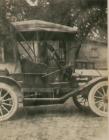 LHS 1908 Reo |
 Rambler |
 Rambler |
These were just a few of the business places featured in The Tribune in 1908 and all of them had large advertisements in that issue, along with the comments by the Ragons.
Return to Lowell History
Return to the "Pioneer History" A to Z Index Page