

Pioneer History by Richard C. Schmal
Lowell Parks, Landmarks and Buildings
(from the Dec. 26, 1984, Lowell Tribune, page 4)In the early days of the Town of Lowell the town square was just an open area, with a few small houses and barns nearby.
There were no monument, buildings or fountain. The land for the Square was given to the town by Dr. Jabez Clark when he platted his addition to Lowell in earlier times. Clark came to Lowell in 1837 and was one of the earliest pioneers in Lake County.
The little park was used for foot races, ice cream socials and band concerts. As time went by, changes were made in the little parcel of land.
At the turn of the century, a tall standpipe or water tower was erected there, used for storage and pressure for the first water system. The big tower stored hundreds of gallons of sulphur water, and many daring young men climbing the iron ladder to the top of that 100-foot standpipe.
The present fountain was placed on the same exact spot after the tower was taken down. The old standpipe was replaced by two water towers, one near Library Park and the other in Evergreen Park.
In June, 1905, 4,000 people crowded the square to watch the dedication of the Three Creeks Monument. The big stone the is over 25 feet high and weighs 45 tons. It lists the names of 504 soldiers, sailors, and one Navy nurse, veterans of the War of 1812, The Mexican War, The Civil War, and the Spanish-American War. Made of fine granite, it was paid for by donations from the good people of the Three Creek Townships.
In 1920, the big event in town was the building of the Lowell Public Library, built on land just to the east of the square. The new building was funded by a donation of over twelve thousand dollars by Andrew Carnegie, and by two thousand dollars contributed by the townspeople. This building replaced an earlier library housed on an upper floor of a downtown store building, and served the area until December of 1969, when the present library was opened at 250 N. Fremont.
On May 2, 1973, the 1920 library building became Lowell's Town Hall.
Now the old square is called "Senior Citizens Park," and is a part of the Lowell Parks and Recreation Dept., with added walks, benches and shrubbery.
Just west of the old square, on the corner, a hitching rack for horses stood for many years on land also given to the town by Jabez Clark. It was a handy place for business men and shoppers to tie their horses, and there were no buildings on the corner until the town of Lowell decided to build a new Town Hall there in 1923. The town offices were moved at that time from a much older building on Mill St.
"It is a building that our citizens can well feel proud of . The lower floor will be used for the office of the town officers. The back part of the lower floor will be used to keep the fire apparatus and also two cells have been placed for use in case of necessity. The lower floor is equipped with toilet, wash rooms, and shower bath. There is a vault where the town records will be kept safely. The upper floor is one large room which can be used for public gatherings and will be found very useful in many ways. The entire building is steam heated. The town board has erected a building that will be adequate for Lowell for a great many years. They had in mind a substantial building and for that reason bought good materials and endeavored to get the best value for their money."
The building did serve for many years, though the volunteer fire department was forced to keep some of their equipment on the lawn at the square at times.
The fire department moved to a larger station on North Fremont St. in 1950. The old fire bell followed them there, and later found a place of honor on the lawn in front of the more modern and larger fire station on the east side to town. Many groups used the meeting room in the town hall for card parties, meetings, and dinners. The brick building, remodeled several times, has been the headquarters of the Lowell Police Dept. since 1973.
Just north of the present police station is the fine old mansion built after the Civil War by Dr. E.R. Bacon, a prominent physician and Civil War veteran. In earlier years, a large windmill could be seen just to the west of the home, with a storage tank and hose.
The water from this well saved the Bacon House from the big fire of 1898, when many buildings on the north side of Commercial Ave. burned to the ground. It is a fine example of earlier architecture, and now houses an antique shop.
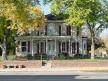 The Bacon House
 Just west of the police station is an old bank building erected in 1891. It was first called the Wiggins Bank, then became the State Bank until 1900, when the name was changed to State National Bank. It was taken over by the Lowell National Bank in 1930. In 1906, the 1891 bank building was owned by John A. Kimmet, whose daughter Lena Kimmet had a millinery shop on the lower floor. She advertised "an extensive stock of all modern and best styles of ladies' hats."
Dr. John E. Davis, a prominent doctor whose story appeared in this column in February 1984, had his office in the upper rooms. For many years after 1925, Martha Smith was the owner of the well-known hat shop, where hats and dresses were made to order.
The "Old Timer" well remembers the doctor who had the rooms upstairs who after Dr. Davis. He was Dr. John Dinwiddie, a dentist and a member of an early pioneer family. In the 1920's Dr. John, assisted by his son Dr. Abott Dinwiddie, fitted braces in the mouth of this writer at a time when not many were worn.
The building, which still boasts a sign that reads "Bank," now houses a travel agency. In future columns we will tell stories of other buildings in our fine town.
Return to Lowell History
Return to the "Pioneer History" A to Z Index Page