

Pioneer History by Richard C. Schmal
The History of Lowell from the Beginning to 1896
(from the Dec. 30, 1987, Lowell Tribune, page 8)(The following story, written by H.H. Ragon of The Lowell Tribune in 1896, was placed in the corner stone of the first Lowell High School, now the old grade school which houses an auction business on Main St. The cornerstone was opened nearly 90 years later, on June 18, 1986. The items so proudly placed there were found to be in poor condition, with dampness and decay. Although the 17 pages of this story were decayed, they were carefully dried and copied by Richard Schmal. Some of the original words are missing, but Schmal has carefully pieced together the tale and added his own explanations in italics to clarify the story.)
Prior to 1836 the site now occupied by our beautiful and thriving city was a wilderness and only the abode of wild beasts. Although perhaps white men had passed over the land now occupied by our town, yet -- no one had taken up his abode on it until the summer and autumn in the above year (1836) when four persons built cabins within the present limits of Lowell. Viz Jacob Mendenhall on the property now owned by Capt. Manning and near his residence in the east part of town. -- John Nolan near the residence of William C. Nichols. -- Horatio Nichols near the present residence of E.B. Ashton. Both of these homes were in the west part of our town. The fourth house was built near the Baptist Church in the north part of town by a man whose name (was) might have been ____.
John Nolan's house was near the present site of the Lowell Post Office, and his claim was purchased by Horatio and Abram Nichols. The first Baptist Church was built in 1857 with the aid of Melvin Halsted, Lowell's founder. the old church building, at the corner of Main St. and Mill St., was purchased by the Presbyterians in June of 1905, was demolished, and a new church finished by 1907. The building is still standing, now occupied by the offices of Dr. Robert Corns. A cabin near that site was occupied for a short time by 1837 pioneer Jabez Clark.
Of these early settlers who had no thought of a town being built here at that time, all so far as we have any knowledge have passed to the great beyond, but Mr. Nichols, who little dreamed that he should sixty years later be present at the laying of the cornerstone of such a magnificent structure dedicated to the uses of education. Time went on and other families arrived in this vicinity and it became apparent that the needs of these farmers must be satisfied in the way of Lumber and building materials. So in 1845 Andrew Ault __ [missing words] ___ the dam that now holds in reserve the water of the Lowell mill pond. He did this with a view to putting in a saw mill, but he sickened and died, and thus the work for a time came to a standstill. In 1848 M.A. Halsted took over the work and completed the first saw mill in all this country. The mill was a great boon to these early settlers as it furnished cheap lumber to improve their homes and farms. In 1853 Mr. Halsted built a grist mill. This perhaps of the many improvement made in our town by Mr. H. was among the greatest as it enabled these early settlers to get their corn and wheat ground into flour and meal without having to go 50 miles or more to get it done.
In 1853 Mr. Halsted laid out or platted 16 lots, most of which he gave away to mechanics, and thus this then was the real start of Lowell as a town.
The saw mill started by Andrew Ault in 1845, and completed by Halsted in 1848, was located south of the Main Street bridge at Cedar Creek, according to an old map. The dam on Main St. was also used to furnish water power for the 1853 grist mill built by Halsted on Mill St. at Jefferson St., now the site of the Palo Theatre. The original 16 lots were along Main St. and in the block bounded by Mill, Jefferson and Clark Streets.
The first school house built within the present limits was erected in 1854, on the south side of what is now Commercial Ave., and about 20 rods west of the public square. Mr. Halsted was contractor and builder of the structure which was 20 x 30 ft., 2 stories high. Previous to the building of this house the pupils in the vicinity attended school in a log house on what is now the property of Capt. Manning. In 1867 the capacity of the little brick school house was outgrown and it became necessary to build larger. So M.A. Halsted, who was the township trustee at that time, planned and built the house that has just give up for this magnificent structure at this time. It was the best house in the county, built by the township at a cost of $7,000. Its size was 40 x 70, two stories high. All the children of the township had access to its school privileges. The first principal of the school was (was left blank) and his assistants were ____ and ____.
The School board advertised for bids on the erection of this building to be opened 1896. It was found that of the bids, Schuyler Sigler of Englewood was the lowest. Accordingly accepted upon the fulfillment of whilch immediately entailed.
The 1854 schoolhouse was located on Commercial Ave. near the site of the Sheets building, now occupied by Lane's Carpets in downtown Lowell. The 1867 brick school house, 40 x 70 feet, was erected on the site of the 1896 building and is still standing on Main St., east of the Lowell Public Library. William Sheets was an early superintendent and D.A. Norris was principal, with Luella Fuller as assistant.
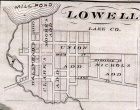
From the original 16 lots laid out by Mr. Halsted in 1853 the town has spread until it is now 360 rods east and west, and 200 rods north and south. The additions were Halsteds, Clarks, Nichols, Moores and Union.
According to an 1876 map of the Town of Lowell, Halsted's addition was between Mill and Clark Streetss, north of Commercial Ave. Clark's addition was between Clark and Union Streets. Nichols addition was between Kankakee St. and Commercial Ave., east of Burnham Street. The Union addition north of Clark and to the east, and the Moore addition was north Clark Street, from Cottage Grove. Some of these developers added more to the town in later years, including the Nichols addition on the west side.
The first church to be organized was the Methodist Episcopal, which was done at the home of E.W. Bryant, by E. W. Bryant and wife, John Kitchel and wife, and Jacob Mendenhall and wife. This organization was effected in 1837. This was the nucleus from which the present M.E. church of Lowell grew. Rev. Colclasior was the first minister that preached in this young congregation. Up to 1870 the congregation was without a house of its own. In that year the present (1896) church building was erected at a cost of $4,000. The present minister is Rev. Sites. The number of members is now 155.
The early home of 1855 pioneer E.W. "Wayne Bryant" was at Pleasant Grove, an early settlement in the area of Lake Dalecarlia. The 1870 Methodist Church was erected at the corner of Burnham and Main Sts., now a vacant lot. The church was sold to the Lutheran Church of Lowell at the time the present Methodist Church was built on Commercial Ave., in 1924.
The Christian Church was organized in 1842. The charter members were Simon Bedle [Beadle] and wife, William Wells and wife, Thos. Childers and wife, and John L. Worley. Mr. Worley, who is one of our most highly respected citizens, is the only one left of those. Nathan Coffenberry was the first preacher. Rev. B.L. Allen officiated in that capacity in 1896. In 1869 the erection of their substantial brick edifice was begun and was occupied for the first time in February 1870. It cost $4,000. Previous to this time meetings were held in dwelling homes, school houses and a rented hall in Lowell. The present membership (1896) including those at Pine Grove, who are under the government of the church at Lowell, is 270. The 1870 Christian Church building was built on the site now occupied by the Lowell National Bank, and was facing Castle St. The Church of Christ is now on Burr St. The Pine Grove Church, which was near the Sanders Cemetery on 205th Ave., near U.S. 41, has been moved and now serves as a residence nearby.
The Baptist Church was organized in Lowell by J.M. Whitehead of Door Village, Ind., Jan. 20, 1856, and Rev. T.H. Ball of Crown Point -- he being chosen the first pastor. The organizers were O.W. Graves, A. Graves, J.A. Hunt, Fannie C. Hunt, M.A. Halsted, Martha Halsted, Roseann Barber, Adelade Drummond, Mary Ann Blayney, John Hunt, Lucy Hunt, Maurice Church. Mr. Church was chosen the first Clerk. The congregation flourished for some time, but has been without a pastor some years. In 1856 Mr. Halsted built the brick church. It stands, not only a landmark of the time, but a monument to the generosity and openheartedness of Mr. Halsted.
The 1856 Baptist Church was torn down in 1907. The Lowell Baptist Church now has a large church and school complex on north Mill St.
The first meeting of Catholics in the view of organizing took place at the home of John Hack in 1860. It was not, however, until 1868 at a meeting held at Sigler's Hall at which one of the Bishops preached that an organization be effected. Meetings were held in the brick factory, since burned down, for about a year. The present frame building was completed in 1871. We have been unable to obtain the name of the first preacher that ministered to this congregation. A priest preached regularly every two weeks in 1896. There are 30 families.
The John Hack home was on the corner of Union and Commercial, now the Lowell National Bank parking lot. The house was moved and is still standing on Lincoln St. The '1871' church, actually erected in 1870, was near the site of Lowell Healthcare Center on Burnham St. The next church facing west on Castle St., was built in 1897, burned in 1914, and was replaced in 1915 by a brick combination church and school, now a part of the nursing home. In 1958 the congregation moved to 10 acres on south Nichols St. Rev. Francis X. Deimel, pastor of St. Mary Church in Crown Point, was the first visiting priest at Lowell.
The second half of H.H. Ragon's story of Lowell will appear in this column in January 1988.
Return to Lowell History
Return to the "Pioneer History" A to Z Index Page