

Pioneer History by Richard C. Schmal
Our Pioneer Doctors, Part Two
(from the April 27, 2004, Lowell Tribune, page 16)- Part one of "Our Pioneer Doctors" published last month, told the three early physicians, with interesting additions taken from the 1952 stories written by Schuyler C. Dwyer, a prominent Lowell attorney and business man who played an important part in local history. Because he was related to two of the doctors and lived in the same neighborhood as others, he was able to add additional interesting information.
Dr. Alfred A. Gerrish (1829-1903)
The January 1982 "Pioneer History" column told the story of the Gerrish family, early settlers of south Lake County, and mentioned Dr. Alred A. Gerrish (1829-1903), who served his patients for many decades. He was the grandson of Col. Henry Gerrish, a Revolutionary soldier and president of the State Bank, the first bank in the Town of Lowell.A story by Schuyler C. Dwyer in 1952 gave more information about the busy physician: "This particularly interesting medic hailed from New Hampshire, was a bachelor throughout his life, and during his early career here, he occupied the second floor rooms of the Dr. Yeoman property [a frame house on the southwest corner of Commercial Avenue and South Union Street]. His obsession was devoting his constant day and night time practice, and saving his earnings therefrom and loaning same to some of the people in the community and thus he became known as the leading lender here before any bank was established.
"He was a long time boarder at the Mee Tavern, then located facing the public square. [The Mee Hotel was later destroyed by fire.] He was known to judge his lending security by looking his borrower straight in the eye, asking, 'Are you honest? Will you surely pay me?' and it seemed that he never lost. In his practice, he occasionally was engaged in a desperate case when he recommended medicine generally not so well known, but which proved to be a life saver."
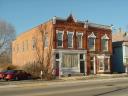 Dwyer wrote that Dr. Gerrish willed his entire estate to a niece from New Hampshire who was his housekeeper. She would not accept the gift, so a "princely sum" went to a multitude of scattered heirs, most of whom were unknown to him. During his later years he erected a portion of the brick apartment building facing the town square, which he occupied for his home and office. Dr. Gerrish passed away in 1903 and is buried in Lake Prairie Cemetery.
Dr. E. R. Bacon (1840-1906)

Bacon started out for himself at a very early age, traveled to Illinois in 1856, moved to Michigan in 1858, and began the study of medicine about the year 1861. At the age of 21, he enlisted in Company E, Second Michigan Volunteers, where he served for three months and was discharged. He then reenlisted in the 100th Illinois Volunteer Regiment, took part in the Battle of Perryville and other important battles, and was discharged in 1865.
Soon after the war he traveled to Lockport, Illinois, where his brother lived, then came to Lowell in May 1866. Schuyler C. Dwyer, who later became his son-in-law, wrote: "On locating here he established one of the first drug stores which was located on the present site of the Masonic Temple building (Colfax Lodge). He then won his bride, Martha Sanger, the only daughter of James Sanger, Sr. He then finished his medical course at Chicago Medical College, and after he was graduated in 1873, established his office in the drug store.
His college diploma and some medical equipment are on display at the Halsted House Museum at the corner of Halsted and Main Streets in Lowell.
His office and drug store were leveled by the big fire of 1898, which destroyed nearly all the building on the north side of Commercial Avenue, from Fremont Street to Mill Street. Dwyer: "The Doctor's residence [northwest corner of Commercial and Fremont] was only saved by spouting water from the hose lines from his underground residential water facilities from his wind mill tower tank. His two barns were destroyed."
Dwyer continues: "This doctor's practice was very extensive, even in the 'horse and buggy days' when he kept three or four driving horses in his two barns, which required a constant hostler in attendance. He had among his patients the renowned Kent family at Kentland. Thus he traveled night and day throughout cold and darkness, mud and mire, summer's heat and storms, as well as pleasant weather. His good nature caused his many patients to say to him that his presence helped them as much as the medicine he delivered, for this was an early period before patients were handed written prescriptions."
Schuyler Dwyer wrote about a remarkable and successful surgery on a grandson of the founder of Lowell, Melvin Halsted. Clifford Halsted was critically injured when a mule kicked him in the forehead, depressing the skull bone and rendering the patient unconscious for days. Unassisted, in a series of procedures elevating the bone by careful degrees, Doctor Bacon returned the bone to its proper place and Mr. Halsted's life was saved.
Dr. E. R. Bacon was very active in the Lowell community, as a member of fraternal groups, as school director and had a professional career marked by continuous advancement and a large patronage. He was also director of the State National Bank of Lowell, owned farm property and Chicago, Illinois, real estate, and served as a trustee of the Methodist Church. He was in poor health in his later years, suffering from diabetes. He fell off a porch, fractured his shoulder and died soon after on Dec. 3, 1906, at the age of 66.
Dr. John E. Davis (1844-1905)
From the February, 1984, 'Pioneer History' column: "John Elkanah Davis was born in Kentucky, one of nine children of Achilles and Melinda Davis, attending schools at McCaffe, Kentucky, and at the age of 23 began to study medicine with his brother, Dr. Henry Davis. Soon after his graduation from the University of Louisville in 1869, he came to Lowell to begin his practice and soon was associated with Charles Post in a drug store. His practice became so large that he was compelled to give up his part in the business. He also was busy with the affairs of the community and was, at times, an associate of Dr. E. R. Bacon."Attorney Dwyer wrote about Dr. Davis: "This pleasant mannered practitioner established his home on the south side of County Road [now Commercial Avenue/Indiana Route 2]. He reared a fine family and was often associated with his neighbor, Dr. Bacon, in some extreme cases which either one may have had."
It is remembered that these two operated a liquor curing establishment in the 1890's, a further benefit to addicts. Dr. Davis was recognized as a careful and tender manipulator in anatomy.
Dwyer explained how the doctor treated a young girl who had an arm wrenched in an accident. He showed her a silver coin, and told her that she could have it if she would reach quickly for it with the hand of her injured arm. She did quickly reach for it and the wrenched arm was cured at once.
Addresses in the Lake County Directory of 1909 include: "Mrs. J. E. Davis, 302 East Commercial Ave." [now 604 E. Commmercial Avenue], where the doctor's widow was living in the large brick home built for Dr. Davis in about 1888, and what is now the west section of the Sheets Funeral Home.
When Dr. Davis died in 1905, his body was escorted from the Methodist Church to the cemetery by 75 members of Colfax Lodge and visiting brethren.
Return to Lowell History
Return to the "Pioneer History" A to Z Index Page